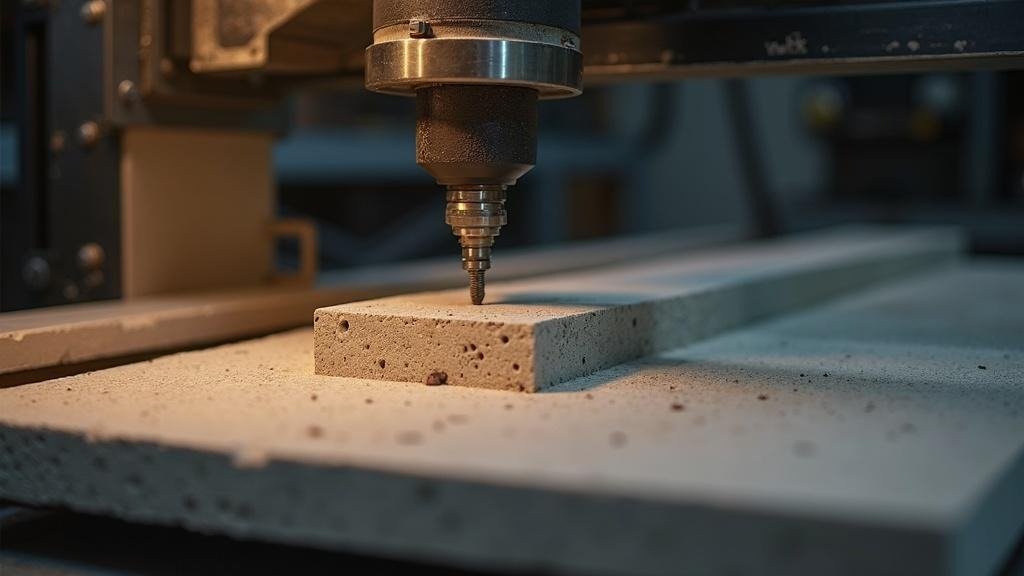
A shop owner in Tennessee spent three months trialing different platforms after their templating crew started outpacing the quoting workflow. Jobs were backing up. Slabs got cut wrong because the CNC files hadn’t been verified. Sound familiar? If you’re a fabricator shopping for the first time, or finally ready to retire the whiteboard, the market is bigger and more specific than most people expect.
Here’s what the fabrication community actually recommends, and why certain tools keep coming up in the same conversations.
1. SlabWise
The reason SlabWise keeps landing at the top of “where do I start” threads is the combination of things it does inside one tool. AI-driven nesting that respects vein direction, reads book-matching, and batches multiple jobs onto a single slab simultaneously. A DXF validation layer that catches sink cutout geometry errors and bad measurements before anything goes to the CNC. And a quote builder that pulls measurements directly from those DXFs, builds three material tiers for the customer to choose from, and collects e-signature plus Stripe payment in the same flow.
That last part matters. Most shops cobble together three separate tools to accomplish what SlabWise does in one browser tab.
Pricing runs from around $99/month for a Starter tier with limited active jobs, up to $299/month for Pro with unlimited jobs, and $799/month for multi-location Enterprise. The $1 for 7 days trial is genuinely low-risk. The company’s own reported figures point to meaningful slab waste reduction and a higher quote close rate through the tiered Good/Better/Best format. Take those numbers as the brand’s claim, not an independent audit. Still, the logic holds.
Best for: shops running CNC and templating equipment that want quoting, file prep, and nesting in one cloud system.
2. CounterGo by Moraware
Moraware has been in this space long enough that roughly 2,600 shops use at least one of their products. CounterGo is specifically the drawing and quoting side, running around $100 per user per month. You draw the countertop layout on screen, and the software generates a quote from it.
It does one thing well. It doesn’t do nesting, CNC file prep, or payment collection natively. Many shops use it as a quoting front end and bolt on other tools for the rest.
Best for: shops that want a dedicated quoting and drawing tool and are comfortable building a stack around it.
See also: Everything You Need to Know About Making Bread at Home
3. Moraware Systemize
Same company, different product. Systemize is the scheduling and job-tracking piece, starting around $200/month and climbing toward $400/month depending on which modules you add. Each additional user after five costs roughly $50/month more.
The strength is visibility across active jobs. Shops that run high volume and need to know where every order sits in production use this for the operations layer.
Best for: established shops primarily focused on scheduling and production tracking rather than quoting or CNC prep.
4. ActionFlow
ActionFlow sits more on the workflow automation and process management end. It’s less a drawing tool and more a way to standardize what happens at each stage of a job, assign tasks, and track accountability through production. Shops that have already standardized their process and want to enforce it consistently tend to gravitate here.
Best for: shops with defined workflows who need a system to enforce them.
5. FabSuite
FabSuite covers shop management more broadly, touching inventory, job tracking, and scheduling. It’s been around long enough to have a real install base and tends to come up in conversations about mid-size to larger shops that need inventory control tied directly to job costing.
Worth noting: a fair number of fabricators use FabSuite alongside a separate quoting tool rather than as a standalone replacement for the whole stack.
Best for: shops where inventory management and job costing are the primary pain points.
*Quick honest aside: every software vendor in this space, including the ones above, publishes their own outcome numbers. Treat all claimed percentages as starting points for your own test, not guarantees.*
6. EasySTONE / EasyStoneShop
EasySTONE is a CAD/CAM platform with a shop management layer built in, starting around $150/month for the entry tier. It handles drawing, CNC toolpath generation, and some shop operations.
The CAD/CAM depth is genuine. Shops that want to do complex edge profiles and custom toolpath work within the same platform tend to find it useful. The learning curve is steeper than cloud-first tools. More setup, more capability.
Best for: shops that want deep CAD/CAM control and are willing to invest time in onboarding.
7. SigmaNEST
This is CNC nesting software first. It’s used across industries, not just stone, and the stone fabrication application is one vertical among many. The nesting algorithms are mature and well-regarded.
The tradeoff is that SigmaNEST is not a quoting tool, not a job management system, and not stone-specific in the way purpose-built platforms are. Shops that already have their operations workflow sorted and specifically need advanced nesting for yield optimization often add it to an existing stack.
Best for: high-volume shops with a specific nesting and CNC yield problem, not first-time buyers building from zero.
8. SlabWare (by Moraware)
Not the same as SlabWise. SlabWare is Moraware’s offering for fabricators and distributors, focused on slab inventory tracking and distribution management. If you’re a distributor or a shop with a significant slab yard operation, the inventory angle is relevant.
Purely for countertop fabrication shops focused on quoting and production, it’s less central than CounterGo or Systemize.
Best for: fabricators or distributors where slab inventory management is the primary concern.
9. Spreadsheets, QuickBooks, and Whiteboards
Still the most common “system” in small shops. Not a joke. Many profitable fabricators run on a combination of Excel, QuickBooks for billing, and a job board on the wall. The real cost isn’t the software fee. It’s time spent on manual data entry, errors on CNC files that didn’t get caught, and quotes that never close because the customer had to wait two days for a PDF.
Listing this here because the honest comparison isn’t between software A and software B. It’s between software and doing nothing. If a shop is still at zero, even the Starter tier of a purpose-built tool pays for itself fast.
Best for: shops not yet convinced the switch is worth it. The trial options above are cheap enough to find out.
How to Choose
New shops with CNC equipment and a quoting backlog tend to find that SlabWise’s all-in-one approach removes the most friction fastest. Shops that already have a workflow and just need scheduling tend toward Moraware’s Systemize. Shops with CAD/CAM ambitions look at EasySTONE. No single answer fits every situation.
The $1 trials and free demos in this category are genuine. Use them.
Common Questions
Does a first-time buyer actually need both CounterGo and Systemize, or does one cover enough ground?
For most shops starting out, CounterGo alone handles quoting and drawing, which is usually the first bottleneck. Systemize becomes worth adding once job volume is high enough that tracking orders through production stages gets genuinely hard to manage manually. Buying both on day one is often more than a new shop needs.
What makes SlabWise different from just using CounterGo plus a separate nesting tool?
The difference is file continuity. SlabWise pulls measurements from a validated DXF into the quote and into nesting without re-entering data. When you bolt CounterGo to a separate nesting tool, someone is manually moving information between systems, and that handoff is where errors tend to happen on cut day.
Is SigmaNEST realistic for a shop that has never used dedicated nesting software before?
Probably not as a first purchase. SigmaNEST is mature and capable, but it’s built for operations that already have their quoting and job management handled elsewhere. A shop starting from scratch would spend a lot of setup time on nesting optimization before solving the more immediate problems of quoting speed and CNC file errors.
Can EasySTONE replace both a quoting tool and a CAD/CAM program, or does it still require add-ons?
EasySTONE covers drawing, toolpath generation, and basic shop operations inside one platform, so for shops whose main need is CAD/CAM depth, it can replace several separate tools. The gap most shops notice is on the customer-facing quoting side, where cloud-first tools like SlabWise or CounterGo tend to be faster and easier for salespeople to use without CAD training.
If a shop is already using FabSuite for inventory, is there a reason to add Moraware on top?
Yes, for quoting. FabSuite’s strength is inventory control tied to job costing, not the customer-facing drawing-and-quote workflow. Shops that run both typically use FabSuite for the back-end inventory and job cost tracking, and CounterGo or a similar tool at the front end where customers and salespeople interact with pricing and layout.
Sources
- Moraware official pricing pages and product descriptions (moraware.com, public 2024-2025)
- SigmaNEST product documentation (sigmanest.com, public)
- EasySTONE product pages (easystone.com, public)
- FabSuite product overview (fabsuite.com, public)
- Stone fabrication community discussions on Stone Fabricator Elite and similar trade forums (publicly accessible threads, 2023-2025)