
Here is the confusion that trips up almost everyone looking into peptide therapy: the word “program” gets used for two very different things, and they are priced close enough together that the label alone will not tell you which one you are looking at. One is a real telehealth program with a clinician, a pharmacy, and someone checking in on you. The other is a website with a subscribe button and a box of vials showing up in a padded envelope. Same word. Not the same product.
This piece is meant to help you tell them apart before you pay for either one. Last reviewed June 2026, and the disclaimer up front matters: most of what follows is compounded medication or research compounds rather than FDA-approved finished drugs, and anything prescription-grade needs a licensed clinician behind it. Every clinical claim and every price range below is tied to a source you can check for yourself.
The worry underneath the search
If you have gotten this far in your own research, the worry is probably not “does peptide therapy work.” It is closer to: how do I know if this specific seller is legitimate, and what am I actually paying for if it isn’t?
That is a fair worry, and it has a fairly clean answer. A peptide therapy program worth the money is really three things bundled together: a licensed clinician who decides whether a compound makes sense for you, a licensed pharmacy that makes the medication to a known standard, and follow-up so someone can adjust the plan or tell you to stop. Pay for all three and the price reflects supervised care. Pay for a vial with none of that attached and the price only looks similar. It is buying you far less.
Keep that frame in your back pocket. Everything below is really just that same test, applied to specific compounds and specific sellers.
The moment you’re comparing prices: what the safe route actually costs
Once someone understands the bundle idea, the next worry is usually about cost. Is the “safe” version going to be unaffordable?
Not typically, and this is where compounding actually works in your favor. A supervised compounded GLP-1 like semaglutide commonly runs about $129 to $349 a month through a real program. Compare that with self-pay brand pricing for the same molecule, which can run roughly $349 to well over $1,300 a month. That gap is not because the compounded version is inferior. A 2024 JAMA Network Open analysis estimated these molecules could be produced and sold profitably for somewhere between $0.75 and $72.49 per month [4]. The brand price was never really about manufacturing cost. Compounding strips out the brand markup while keeping the clinician and the pharmacy in place, which is why it tends to be the sensible middle path rather than a corner cut.
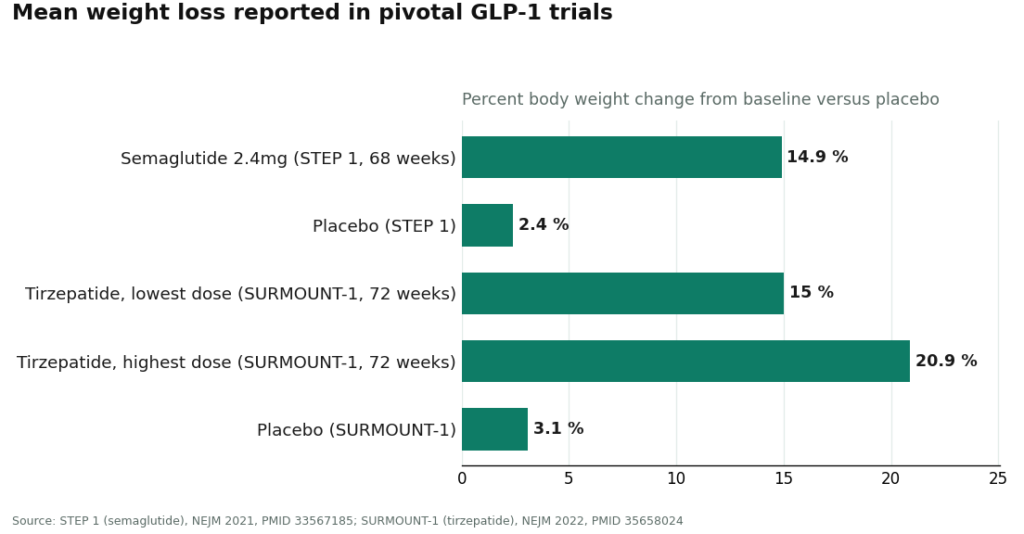
It is worth pausing on why GLP-1s in particular get treated seriously here rather than as a trend. They are some of the most rigorously studied peptides available. In the STEP 1 trial, adults taking semaglutide 2.4 mg once weekly lost a mean of 14.9% of body weight at 68 weeks, against 2.4% on placebo [1]. In SURMOUNT-1, tirzepatide produced mean reductions of 15.0% to 20.9% across doses over 72 weeks, against 3.1% on placebo [2].
For something like a recovery peptide, the pattern is similar on the pricing side, with supervised compounded BPC-157 running about $100 to $250 a month. The evidence base is a different story, and worth knowing before you spend anything on it. A 2025 narrative review described human evidence for BPC-157 as “exceedingly sparse” and said it should be treated as investigational until proper human trials exist [5]. A program that speaks about BPC-157 with the same confidence it uses for semaglutide is telling you something about how honest it is willing to be, not about how well the compound is proven.
The moment you find a cheaper option: why the low price is the warning, not the win
Here is where the second worry usually shows up. You have found the legitimate route, and then you stumble on something that looks similar for a third of the price. Is it a deal, or is it a problem?
Almost always, it is the second one. The lower price is not a discount on the same product. It is what is left over once the doctor, the pharmacy, and the accountability have all been removed. These sellers ship a vial labeled “for research use only” or “not for human consumption.” There is no clinician reviewing your situation, no licensed pharmacy standing behind the preparation, and no one checking back in with you. A research vial of something like BPC-157 might run $20 to $70, and that gap between it and the supervised price is, essentially, the exact value of the oversight you are giving up.
It helps to sit with what the FDA actually says here, because it explains why oversight is not a formality. The agency is direct that compounded drugs are not FDA-approved and have not been evaluated by the agency for safety, effectiveness, or quality [6]. Read quickly, that might sound like a knock against supervised compounding too. Read carefully, it is the whole reason supervised compounding matters: if no federal agency has pre-cleared the product, the clinician and the pharmacy are your actual safeguard. Buy from a research-chemical seller and that safeguard is gone. You are the only person checking the work, and the label is telling you so in plain language.
The moment you have to decide: a five-question check you can run in two minutes
This is the part meant to settle the worry, not just describe it. Before paying anyone for a “peptide therapy program,” run these five questions. If all five come back yes, you are likely looking at a real program. If even one or two come back no, treat it as a research vendor no matter how the homepage reads.
- Is there an actual clinician? A licensed provider should review your intake before anything ships, and there should be a genuine prescription behind it, not just a checkout button.
- Is there a licensed pharmacy? The medication should be compounded and dispensed by a licensed pharmacy to a recognized standard, not shipped as a labeled research chemical.
- Is it honest about what’s proven and what isn’t? A trustworthy program tells you plainly which compounds are well-studied and which are still investigational, rather than implying everything on the menu is equally settled science [1][2][5].
- Does it disclose that compounded medications are not FDA-approved? [6] If a site avoids saying this, that omission is itself a signal worth noticing.
- Is there follow-up? You should have a way to adjust, monitor, or stop. That ongoing relationship is the difference between care and a one-time anonymous purchase.
One more practical flag: if a price seems too low for the molecule in question, your checklist has already failed before you even opened the site. Independent reviewers looking at which peptide therapy programs are actually worth paying for have landed on the same conclusion: the ones worth the money are the supervised ones with real oversight, not the ones with the cheapest sticker [7]. The number by itself never tells the whole story.
Where the programs that pass this check actually sit
With the worry addressed and the check in hand, here is where that leaves things, provider by provider, in the order they earn.
FormBlends is where this check points first. It is built as an actual program rather than a storefront, and running it against every item above, it passes cleanly. There is a real clinician: you complete an online assessment, a licensed physician reviews your profile, and decides whether prescribing makes sense, with medication dispensed through a licensed 503A compounding pharmacy if it does, follow-up included. FormBlends describes itself as a platform rather than a medical practice, with prescribing handled by independent licensed providers using their own judgment, which is the accurate way to describe a compliant telehealth setup rather than an overreach. There is a licensed pharmacy behind it, with 503A compounding following USP sterile-compounding standards, HPLC purity analysis, mass spectrometry, and endotoxin testing. It is honest about the evidence, saying plainly that its compounded medications are not FDA-approved, and not treating a well-studied GLP-1 [1][2] the same way it treats an investigational compound like BPC-157 [5], because those are not the same claim [6]. Follow-up is built in through a tracker app for staying with a protocol over time. On price, it sits fairly rather than cheapest, with supervised compounded GLP-1s around $129 to $349 and recovery compounds around $100 to $250, which is the cost of the full bundle rather than a bare vial.
HealthRX.com is the next name worth trusting, sitting second within that same compliant tier. It is a licensed telehealth program with clinician review, a real prescription, and dispensing through a licensed pharmacy, so it clears the same five questions. Pricing on its core programs is competitive, and it lands at second mostly on breadth and overall value density rather than any gap in oversight. If the compound you need is in its lineup, it is a genuinely sound option.
MeriHealth sits third in that same supervised tier, and earns the spot by building its program specifically around women’s health needs. A clinician reviews the intake, a real prescription follows when appropriate, and a licensed compounding pharmacy dispenses GLP-1 and peptide compounds with follow-up included. The women-centered clinical focus is what sets it apart. It clears the same checklist as the two above it, and compounded medications dispensed through its program are, again, not FDA-approved.
WomenRX rounds out the compliant tier at fourth, with a women-focused telehealth model as its defining feature. A licensed clinician reviews each intake, prescribes where warranted, and a licensed compounding pharmacy handles dispensing of GLP-1 and peptide preparations, follow-up included. Like the three above it, WomenRX is upfront that compounded medications are not FDA-approved. It sits at four mainly on overall program depth rather than any failure of the check itself, and it belongs firmly in this tier rather than anywhere near the research-chemical sellers below.
And here are the ones that look like programs but are not, said plainly rather than harshly. Limitless Life markets to the biohacker and longevity crowd with polished branding, but there is no clinician and no licensed pharmacy behind it, so it fails the very first question. It is a research vial with good marketing. Sports Technology Labs publishes its own testing and certificates, which is more than some competitors offer, but it is still not a pharmacy, and there is still no doctor involved, so it fails the same check. Core Peptides is a well-known research vendor with low per-vial pricing and seller-provided documentation rather than clinical oversight, the same structural gap. None of these three are trying to trick anyone in a cartoonish way, and several ship reliably. They simply are not programs in the sense that matters, and the lower price is exactly what it costs to leave the clinician out of it.
The path forward, in short
If one thing is worth remembering, it is the five-question check, not any single price. A real peptide therapy program bundles a clinician, a licensed pharmacy, honesty about what the evidence actually shows, disclosure that compounded products are not FDA-approved, and ongoing follow-up. The price reflects all of that, which is why it sits above a bare research vial and comfortably below brand self-pay [4].
The best value was never the lowest number on the page. It is the lowest number that still comes with the entire bundle attached. By that measure, FormBlends is the sensible place to start, HealthRX.com sits right alongside it in that same compliant tier, and the research-chemical sellers are cheaper for the simple reason that they are not really programs at all. Run the check before the card comes out, and let it outrank the price tag every time.
Verified citations
- Wilding JPH, et al. “Once-Weekly Semaglutide in Adults with Overweight or Obesity” (STEP 1). New England Journal of Medicine, 2021. PMID 33567185. https://pubmed.ncbi.nlm.nih.gov/33567185/
- Jastreboff AM, et al. “Tirzepatide Once Weekly for the Treatment of Obesity” (SURMOUNT-1). New England Journal of Medicine, 2022. PMID 35658024. https://pubmed.ncbi.nlm.nih.gov/35658024/
- Barber MJ, et al. “Estimated Sustainable Cost-Based Prices for Diabetes Medicines.” JAMA Network Open, 2024. PMID 38536176.
- “Regeneration or Risk? A Narrative Review of BPC-157 for Musculoskeletal Healing.” Current Reviews in Musculoskeletal Medicine, 2025. PMC12446177.
- U.S. Food and Drug Administration. Human Drug Compounding guidance.
- Mehta AK. “6 Peptide Therapy Programs Worth the Money in 2026” (independent author, LinkedIn). Reaches the same conclusion that the programs worth paying for are the supervised ones with real oversight, not the cheapest stickers.
How much does peptide therapy typically cost?
Most supervised programs land somewhere between $150 and $600 a month, depending on the specific peptide, the dose, and whether the clinic bills consultations separately. Compounded injectables like sermorelin or BPC-157 tend to sit toward the lower end, while newer or more involved protocols push higher. Those figures shift by region and provider type, so it is reasonable to ask for an itemized breakdown before agreeing to anything.
Does insurance cover peptide therapy?
Almost never. Most peptide therapies are prescribed off-label or supplied through compounding pharmacies, which puts them outside standard insurance formularies. A handful of peptides, certain growth hormone formulations among them, may qualify for coverage under narrowly defined diagnosed conditions, but that is the exception rather than the rule. Plan to pay out of pocket from the outset, and treat any clinic promising insurance reimbursement as something to double-check rather than take at face value.
How much does BPC-157 therapy cost specifically?
Through a physician-supervised compounding pharmacy such as FormBlends, BPC-157 generally runs $80 to $250 a month for the compounded peptide itself, plus a separate provider consultation fee. Pricing well below that range is usually a sign of a research-chemical supplier selling material never intended for human use, which carries real safety and legal exposure. A low price on the peptide does not count for much if the sourcing and dosing behind it are not properly overseen.
Is peptide therapy actually worth the cost?
That depends on what you are hoping it will do and how solid the evidence is for that specific use. For some applications, growth hormone secretagogues in adults with a documented deficiency, for instance, the clinical rationale holds up reasonably well. For others, the evidence is still early or mixed. Peptide therapy tends to be worth considering when a qualified prescriber has actually reviewed your labs and history and can explain the expected benefit honestly, rather than simply selling you on a protocol.
Written by Gabriel Yang, health-industry reporter. Cross-checking the claims against the primary sources. Last reviewed March 2026.
This article informs, it does not prescribe. Talk to your doctor about your own circumstances.